¿Cómo funcionan las tasas de interés hipotecarias?

Una guía sencilla para compradores de casa y agentes

Cuando una persona empieza a buscar casa, una de las primeras preguntas que suele hacer es:


“¿Cómo están las tasas hipotecarias ahorita?”


Pero en realidad, hay una pregunta todavía más importante:


“¿Cómo funcionan realmente las tasas de interés hipotecarias?”


Entender cómo se determinan las tasas, por qué suben o bajan y cómo afectan el pago mensual puede ayudar a los compradores a tomar decisiones más inteligentes.


Y también puede ayudar a los Realtors a orientar mejor a sus clientes durante el proceso de financiamiento.


Vamos a explicarlo de forma sencilla.


¿Qué es una tasa de interés hipotecaria?


La tasa de interés hipotecaria es el costo que paga un comprador por pedir dinero prestado para comprar una casa.


Cuando una persona obtiene una hipoteca, el prestamista le está proporcionando una cantidad grande de dinero para comprar la propiedad.


A cambio, el comprador devuelve ese dinero poco a poco con pagos mensuales… más intereses.


Ese interés se expresa como un porcentaje del monto del préstamo.


Ejemplo:

  • Monto del préstamo: $500,000
  • Tasa de interés: 6.5%


El comprador paga intereses cada mes sobre el saldo restante del préstamo como parte de su pago hipotecario.

¿Por qué cambian las tasas hipotecarias?


Las tasas hipotecarias pueden cambiar todos los días… e incluso varias veces en un mismo día.

Eso sucede porque están influenciadas por varios factores importantes en la economía.


1. La inflación


La inflación es uno de los factores más importantes que afectan las tasas hipotecarias.


Cuando la inflación está alta, los prestamistas normalmente exigen tasas más altas para compensar la pérdida del valor del dinero con el tiempo.


Cuando la inflación empieza a bajar, las tasas hipotecarias también suelen bajar.


En pocas palabras:

  • Inflación alta = tasas más altas
  • Inflación más controlada = tasas más bajas


2. El mercado de bonos


Las tasas hipotecarias están muy relacionadas con el mercado de los Mortgage-Backed Securities (MBS), o valores respaldados por hipotecas.


En términos simples, muchas hipotecas se agrupan y luego se venden a inversionistas en forma de bonos.


¿Qué significa eso para un comprador?

  • Si los inversionistas quieren comprar esos bonos, las tasas tienden a bajar
  • Si los inversionistas venden esos bonos, las tasas tienden a subir


Por eso muchas veces escucharás que las tasas hipotecarias se mueven junto con el Treasury a 10 años.


3. La política de la Reserva Federal (Fed)


La Reserva Federal no determina directamente las tasas hipotecarias, pero sus decisiones sí tienen un impacto importante en el mercado.


Cuando la Fed ajusta las tasas de interés a corto plazo o implementa medidas para controlar la inflación y apoyar la economía, los mercados financieros suelen reaccionar rápidamente.


Como resultado, esas decisiones también pueden influir en el comportamiento de las tasas hipotecarias.


4. Los reportes económicos


Las tasas hipotecarias también reaccionan a ciertos reportes económicos importantes, como:


  • Inflación (CPI y PCE)
  • Números de empleo
  • Crecimiento del GDP
  • Gasto del consumidor


Generalmente:

  • Datos económicos fuertes → pueden empujar las tasas hacia arriba
  • Datos económicos débiles → pueden ayudar a que las tasas bajen

¿Cómo afectan las tasas hipotecarias al pago mensual?


Aquí es donde realmente se vuelve importante para la mayoría de los compradores.


Incluso un pequeño cambio en la tasa puede hacer una gran diferencia en el pago mensual.


Ejemplo en un préstamo de $500,000:

Tasa Pago aproximado

5.5%. $2,838

6.0%. $2,998

6.5%. $3,160

7.0%. $3,327


Esa diferencia de solo medio punto o un punto puede representar cientos de dólares más al mes.


Por eso hoy en día muchos compradores no solo están viendo el precio de la casa…


También están viendo si el pago mensual realmente les funciona.


¿Por qué dos compradores pueden recibir tasas diferentes?


No todos los compradores reciben la misma tasa.


La razón es simple: la tasa se basa en el nivel de riesgo del préstamo.


Hay varios factores que influyen en la tasa que un comprador puede recibir.


1. Puntaje de crédito


El credit score tiene un impacto importante en la tasa.


En general, entre mejor sea el crédito, mejor puede ser la tasa ofrecida.


Ejemplo general:

  • 740+ → mejor precio
  • 700–739 → ajuste ligero
  • 660–699 → ajuste moderado
  • Menos de 660 → ajustes más altos


2. El enganche (down payment)


Entre más dinero ponga el comprador como enganche, menor riesgo representa para el prestamista.


Ejemplo:

  • 20% de enganche → mejor precio
  • 10% de enganche → ajuste ligero
  • 3% a 5% de enganche → mayor ajuste por riesgo


Más equity normalmente significa mejores condiciones.


3. El tipo de préstamo


No todos los programas hipotecarios manejan las mismas tasas.


Tipos comunes de préstamo:

  • Convencional
  • FHA
  • VA
  • Jumbo
  • ARM (Adjustable Rate Mortgage)


Dependiendo del perfil del comprador, en algunos casos un préstamo FHA puede ofrecer una mejor tasa que un préstamo convencional.


4. El uso de la propiedad (occupancy)


La tasa también cambia dependiendo de cómo se va a usar la propiedad.


Generalmente:

  • Primary Residence (casa principal) → mejores tasas
  • Second Home (segunda casa) → un poco más altas
  • Investment Property (propiedad de inversión) → todavía más altas


Esto sucede porque para el prestamista, una propiedad de inversión representa más riesgo.

¿Qué son los puntos hipotecarios?


Los compradores también tienen la opción de bajar su tasa de interés pagando lo que se conoce como discount points.


Un punto generalmente equivale al 1% del monto del préstamo.


Ejemplo:

  • Monto del préstamo: $500,000
  • 1 punto = $5,000


Pagar puntos al inicio puede ayudar a conseguir una tasa más baja y, por lo tanto, un pago mensual más bajo.


Hoy en día, muchos compradores están usando seller credits para ayudar a cubrir este tipo de estrategias durante la negociación de compra.


Tasa fija vs. tasa ajustable


Otra parte importante que muchos compradores deben entender es la diferencia entre una hipoteca de tasa fija y una hipoteca de tasa ajustable (ARM).


Hipotecas de tasa fija


En una hipoteca de tasa fija, la tasa de interés se mantiene igual durante todo el plazo del préstamo.


Opciones comunes:

  • 30-year fixed
  • 20-year fixed
  • 15-year fixed


Estas opciones ofrecen más estabilidad a largo plazo porque el pago principal e interés no cambia.


Hipotecas de tasa ajustable (ARMs)


Las ARMs comienzan con una tasa fija más baja durante un periodo inicial, y después esa tasa puede ajustarse con el tiempo.


Ejemplos comunes:

  • 5/1 ARM
  • 7/1 ARM
  • 10/1 ARM


Estas opciones pueden ofrecer pagos iniciales más bajos, lo cual puede ser atractivo especialmente en mercados con tasas altas.


Hoy más que nunca, la estructura del préstamo importa


En el mercado actual, no siempre se trata solamente de conseguir “la tasa más baja”.


Muchas veces, lo que más importa es cómo se estructura el financiamiento.


Tanto prestamistas como Realtors están utilizando estrategias como:

  • Temporary rate buydowns
  • Seller credits
  •  Adjustable-rate mortgages
  • Down payment assistance
  • Estrategias creativas de financiamiento


En muchos casos, una hipoteca bien estructurada puede ayudar más al comprador que simplemente esperar a que las tasas bajen.


Conclusión


Las tasas de interés hipotecarias están influenciadas por la economía, la inflación, los mercados financieros y también por factores específicos de cada comprador.


Aunque muchas personas solo ven la tasa “general” que aparece en internet, la realidad es que:


Cada comprador puede tener una tasa diferente.


Entender cómo funcionan las tasas ayuda a los compradores a tomar mejores decisiones…


Y ayuda a los Realtors a guiar a sus clientes con más confianza durante una de las decisiones financieras más importantes de sus vidas.


¿Tienes preguntas sobre tasas hipotecarias, programas de préstamo o estrategias de financiamiento?


En Fresh Home Loan estamos aquí para ayudarte a encontrar la estructura correcta para tu compra o refinanciamiento.


Garrick Werdmuller

President & CEO

Fresh Home Loan Inc.

(510) 282-5456

garrick@freshhomeloan.com

www.FreshHomeLoan.com


Diana Diaz

Operations Manager
Fresh Home Loan Inc. 

(510) 751-0303

customercare@freshhomeloan.com

www.FreshHomeLoan.com


Contáctanos aquí:

https://www.freshhomeloan.com/contact-us


All loan approvals are conditional and not guaranteed and subject to lender review of all information. Loan is conditionally approved when the lender has issued approval in writing, but until all conditions are met, loan cannot be funded. Specified rates and [products may not be available to all borrowers. Rates subject to change according to market conditions and agreed upon lock times set by the borrower. Fresh Home Loan Inc. is an Equal Opportunity Mortgage Broker in California. This licensee is performing acts for which a real estate license is required. Fresh Home Loan, Inc. is licensed by the California Department of Real Estate #02137513 NMLS # 2124104


#FreshHomeLoan #Hipotecas #TasasDeInteres #ComprarCasa #PrimerComprador #Realtor #BienesRaices #EducacionFinanciera #CreditoHipotecario #CaliforniaRealEstate



By Garrick Werdmuller April 7, 2026
En el entorno digital de hoy, muchos consumidores monitorean su crédito utilizando aplicaciones populares y herramientas en línea. Aunque estas plataformas brindan información útil, también pueden crear una falsa sensación de seguridad al prepararse para comprar una vivienda. La realidad es simple: No existe un solo puntaje de crédito universal. En cambio, existen múltiples modelos de puntuación, y cada uno está diseñado para un tipo específico de decisión financiera. Comprender esta diferencia es fundamental tanto para los compradores de vivienda como para los profesionales de bienes raíces. Diferentes industrias utilizan diferentes modelos de crédito El crédito se evalúa de manera distinta según el tipo de financiamiento que se esté considerando. • Los prestamistas de autos priorizan el historial en préstamos de auto a plazos • Los emisores de tarjetas de crédito se enfocan en el uso del crédito rotativo y la utilización disponible • Los brokers hipotecarios se centran en patrones de pago a largo plazo y consistencia financiera Como resultado, el puntaje de crédito de un consumidor puede variar considerablemente dependiendo del modelo que se utilice. Por ejemplo, una persona puede ver un puntaje de 720 en una aplicación para monitorear crédito, mientras que su puntaje específico para hipoteca podría estar más cerca de 680 .  Esta diferencia no es un error; simplemente refleja el uso de un modelo de puntuación distinto.
By Garrick Werdmuller April 7, 2026
In today’s digital landscape, many consumers monitor their credit using popular apps and online tools. While these platforms provide useful insights, they can also create a false sense of confidence when preparing for a home purchase. The reality is simple: There is no single, universal credit score. Instead, there are multiple scoring models, each designed for a specific type of lending decision. Understanding this distinction is critical for both homebuyers and real estate professionals. Different Industries Use Different Credit Models Credit is evaluated differently depending on the type of financing being considered. Auto lenders prioritize performance on installment-based auto loans Credit card issuers emphasize revolving credit behavior and utilization Mortgage lenders focus on long-term repayment patterns and financial consistency As a result, a consumer’s credit score can vary significantly depending on which model is used. For example, a consumer may see a 720 score through a credit monitoring app , while their mortgage-specific score may be closer to 680 . This discrepancy is not an error—it reflects the use of a different scoring model.
By Garrick Werdmuller March 26, 2026
A Simple Guide for Homebuyers and Realtors
By Garrick Werdmuller March 19, 2026
Get Your Official Copy of Reverse Mortgage Self-Evaluation: A Checklist of Key Considerations from the NRMLA (National Reverse Mortgage Loan Association)
By Garrick Werdmuller March 13, 2026
Fresh Home Loan Marketing: What We Actually Deliver for Agents, Listings, and Buyers
By Garrick Werdmuller March 12, 2026
Building a home can feel complicated, but a One-Time Close New Construction loan helps simplify the process by combining construction financing and permanent mortgage financing into one loan. What is a One-Time Close New Construction loan? A One-Time Close New Construction loan is a single-close construction loan . It provides short-term financing for the construction of a new home, then converts into permanent mortgage financing once the project is complete. This type of loan can typically be structured as either a purchase or a refinance . What does “one-time close” mean? A one-time close construction loan combines: The financing for the construction phase The permanent mortgage after the home is completed There is one closing before construction begins , instead of separate closings for construction and permanent financing. At closing: The borrower’s required closing costs and funds are collected Construction funds are held and released through draws The builder typically receives an initial draw to begin the project What is a One-Time Close New Construction purchase loan? This is considered a purchase when the borrower does not already own the lot . The loan is used to finance: The purchase of the lot The cost to build the home The total loan amount is generally based on the lot purchase price plus construction costs , minus the borrower’s required down payment. What is a One-Time Close New Construction refinance loan? This is considered a refinance when the borrower already owns the lot the home will be built on. The loan is used to: Pay off any existing liens on the land, if applicable Finance construction of the new home The loan amount is generally based on the existing lot financing, if any, plus the cost to build the home . Can I build a barndominium or other unique property? Possibly. Barndominiums and other unique property types may be eligible depending on the loan program guidelines and whether the appraisal can support the value with comparable sales in the area. Unique properties are often more appraisal-sensitive, so approval depends heavily on market support. What happens if the build takes longer than expected? The builder and borrower agree on the expected construction timeline upfront. During the build, inspections and permit reviews are typically completed before draws are released, which helps identify delays early. If the project runs longer than expected: Updated credit or income documents may be required if prior documents expire The borrower may need to be requalified if major eligibility issues arise The lender will review the file and determine what updated documentation is needed How many units are allowed on one parcel? Programs may allow up to 4 attached units on one parcel , depending on the loan type and guidelines. An Accessory Dwelling Unit (ADU) may also be allowed, but it typically counts as a unit, subject to local zoning and program rules. If there is an ADU on the parcel, the principal residence may be limited to 3 units . Can I build a home with a pool, ADU, detached garage, or other upgrades? Yes, borrowers can usually build to the specifications they agree on with their builder. However, financing for those features depends on whether the appraised value supports the total cost . If the project cost exceeds the program’s maximum loan-to-value limits, the borrower may need to bring additional funds to closing. Can I build on land that already has a home on it? Typically, land with an existing dwelling is not eligible for a standard One-Time Close New Construction transaction unless the property is legally re-parceled to separate the new build from the existing structure. Can I demolish an existing home and build a new one? In some cases, yes. For certain conventional transactions, the existing foundation may be reused if it meets local building code and program requirements. For VA transactions, the existing foundation generally cannot be reused, and the new construction must follow VA-specific guidelines. Can demolition costs be included in the loan? In many cases, yes. Demolition costs can often be included in the construction budget. As with other project costs, financing depends on whether the appraised value supports the total project and whether the loan stays within program limits. Any amount above allowed limits may need to be paid by the borrower at closing. Do the builder and project need to be approved before submitting the loan? Builder and project approval may not always be required before initial submission, but it is strongly recommended to have them reviewed early. Final approval is generally needed before the loan can receive final clearance to close. Early review helps avoid surprises and keeps expectations clear for all parties. How is the borrower’s down payment or cash to close applied during construction? When a borrower brings funds to closing, those funds are generally applied first toward: Closing costs Initial project costs Early draws, depending on the structure of the loan After those funds are used, the remaining construction costs are funded through the loan proceeds. When does the builder receive the initial draw? After closing, construction funds are held in escrow and disbursed once all required conditions for the first draw are met. The initial draw is typically released after approval and setup are complete. Timing can vary, but builders should expect a short processing period before funds are disbursed. Can the builder give a credit toward closing costs? Yes, builder credits may be allowed, but they must comply with interested party contribution limits for the applicable loan program. These credits are typically reflected in the transaction and may reduce the funds otherwise paid to the builder. What happens if the borrower has questions after closing? After the loan closes, the borrower will usually receive welcome and servicing information explaining how the construction loan will be administered. Borrowers should contact their loan servicer or construction servicing team for questions about: Payments Draw process Construction servicing Loan modification into permanent financing Fresh Home Loan can also help guide borrowers on who to contact. Does the builder have to use a specific budget form? It is often best for the builder to complete the lender’s preferred construction budget form if one is available. However, a builder’s standard budget may also work as long as it includes all required construction details, line items, and costs. What if the construction budget changes before closing? If the budget changes before closing, an updated budget and any required contract addendum will typically need to be submitted. The loan file may need to be updated, and in some cases an additional review fee may apply if the changes are significant. Can a borrower be reimbursed for construction items paid before closing? Generally, borrowers should not expect reimbursement in cash for construction items they prepaid before closing. For some conventional refinance transactions, prepaid builder deposits may not be reimbursable through loan proceeds. How do interest-only payments work during construction? During the construction phase, the borrower typically makes interest-only payments based on the amount of funds that have been disbursed. In some cases, builder-paid interest arrangements may be structured into the transaction if allowed by the loan program and documented properly. Borrowers usually receive monthly statements showing construction-period interest activity. Can there be an escrow holdback if the project is delayed by weather? Generally, escrow holdbacks are not allowed on standard One-Time Close Conventional or VA construction loans. Builders should account for seasonal conditions when planning the project timeline. How does the builder receive the final draw? Before the final draw is released, a final inspection is usually required to confirm that the work has been completed according to plan. Final draw processing can take additional time, so builders and borrowers should plan ahead near the end of the project. Are owner-builders allowed? Owner-builders may be allowed on certain conventional One-Time Close programs, but they typically must go through a builder approval process. Additional requirements may apply, including: Higher down payment requirements Stronger reserves Additional documentation Stricter qualification standards Can a borrower who already started construction transition into a One-Time Close loan? Sometimes, yes — but usually only on certain conventional programs. If construction has already started, the lender will typically require: Permits Inspections Documentation of completed work Updated budget and plans This type of scenario is more complex and may have added restrictions. Can borrowers be reimbursed for materials they bought outside the loan? Borrowers generally cannot receive cash reimbursement for materials purchased outside of the transaction. However, in some cases, those contributions may be credited as equity toward the borrower’s down payment, subject to documentation and program approval. Can future rental income from the property be used to qualify? No. Future rental income from the subject property typically cannot be used to qualify for a One-Time Close New Construction loan. Important note One-Time Close New Construction loans can be a great option, but guidelines vary based on: Loan type Occupancy Property type Builder approval Appraisal support Borrower qualifications That is why it is important to review the project upfront with a knowledgeable mortgage professional. Questions about your construction project? We help homebuyers and Realtors understand the financing side of building a home — from lot purchase to final permanent financing. Reach out to Fresh Home Loan to review your scenario. Garrick Werdmuller President & CEO Fresh Home Loan Inc. (510) 282-5456 garrick@freshhomeloan.com www.FreshHomeLoan.com All loan approvals are conditional and not guaranteed and subject to lender review of all information. Loan is conditionally approved when lender has issued approval in writing, but until all conditions are met, loan cannot be funded. Specified rates and [products may not be available to all borrowers. Rates subject to change according to market conditions and agreed upon lock times set by borrower. Fresh Home Loan Inc. is an Equal Opportunity Mortgage Broker in California. This licensee is performing acts for which a real estate license is required. Fresh Home Loan, Inc. is licensed by the California Department of Real Estate #02137513 NMLS # 2124104 #OneTimeClose #ConstructionLoan #BuildYourDreamHome #HomeConstruction #HomeBuildingProcess #MortgageEducation #HomeBuyingTips #RealEstate #FirstTimeHomeBuyer #MortgageBroker #LoanPrograms #FreshHomeLoan 
By Garrick Werdmuller March 4, 2026
In today’s California real estate market, seller credits are making a strong comeback. As mortgage rates remain elevated and buyers become increasingly payment-focused, seller concessions are no longer just a closing cost tool — they are a strategic financing solution. Fresh Home Loan Inc., led by independent mortgage broker Garrick Werdmuller (DRE 01368202 | NMLS 242952), has released the Realtor® Home Buyers Seller Credit Cheat Sheet to help agents and buyers structure smarter offers in today’s lending environment. Understanding how seller credits work — and how to use them properly — can be the difference between a deal falling apart and a deal closing cleanly. What Are Seller Credits? Seller credits (also called seller concessions) are negotiated funds the seller agrees to contribute toward a buyer’s allowable closing costs. Instead of reducing the purchase price, the seller allocates funds at closing to cover approved expenses under lending guidelines. In many cases, structured seller credits create stronger financial outcomes than price reductions alone. Why Seller Credits Matter in Today’s Market California buyers are currently navigating: Higher mortgage rates Payment-driven affordability concerns Reduced liquidity among first-time buyers Appraisal sensitivity in softening price pockets Increased use of temporary and permanent rate buydowns Because buyers are payment-focused, not price-focused, strategic seller credits can: Lower monthly payments Preserve appraisal value Improve qualification ratios Keep more cash in the buyer’s bank account Negotiation structure is outperforming price reductions. What Seller Credits CAN Be Used For Under FHA, conventional, and other agency guidelines, seller concessions may typically be used for: 1. Closing Costs Lender fees (origination, underwriting, processing) Appraisal and credit report Title and escrow fees Recording fees Flood certification Attorney fees (where applicable) These are the most common uses of seller concessions. 2. Prepaid Items Seller credits may cover prepaid costs required at closing, including: Homeowners insurance Property taxes Per diem mortgage interest HOA dues (where applicable) This can significantly reduce the buyer’s required cash to close. 3. Interest Rate Buydowns (Power Move) One of the most powerful uses of seller credits in 2026 is for rate buydowns. Temporary Buydowns 2-1 buydown 1-0 buydown These reduce the buyer’s payment for the first one or two years. Permanent Buydowns Discount points to permanently reduce the interest rate In a higher-rate environment, structured credits toward discount points can dramatically improve affordability. 4. Mortgage Insurance (MI) Seller concessions may be used toward: FHA Upfront Mortgage Insurance Premium (UFMIP) Certain lender-paid mortgage insurance structures on conventional loans This can help optimize long-term payment strategy. 5. Repairs or Credits in Lieu of Repairs Post-inspection negotiations may include seller credits for: Health and safety repairs Deferred maintenance Repair credits instead of seller-completed work This must comply with lender and appraisal guidelines. 6. HOA and Condo Costs For condos and planned developments, credits may cover: HOA transfer fees HOA dues at closing Condo document fees What Seller Credits CANNOT Be Used For There are clear compliance limits. Seller concessions generally cannot be used for: Down payment Cash back to buyer Paying off buyer’s personal debt Furniture or personal property Side agreements outside escrow Exceeding concession limits can create underwriting delays or contract amendments. Understanding the boundaries protects approval confidence. Seller Credits vs. Price Reduction: Which Is Better? Many agents assume reducing the purchase price is always best. But consider this example: A $20,000 price reduction may lower the monthly payment only marginally. The same $20,000 structured as seller credits could: Buy down the interest rate Lower the buyer’s payment more aggressively Reduce required cash to close Improve debt-to-income qualification Preserve appraised value Payment structure closes transactions. Seller Concession Limits Matter FHA, conventional, and other loan types have maximum allowable seller concession percentages based on: Loan type Down payment Occupancy Purchase price Structuring credits within guidelines is critical to ensure a clean approval. This is where working with an experienced independent mortgage broker matters. Strategic Takeaway for California Realtors Seller credits are no longer just a closing cost offset. They are: A negotiation advantage A payment strategy tool A qualification improvement lever A liquidity preservation mechanism A compliance-sensitive structuring opportunity Agents who understand seller credit strategy will outperform those who rely solely on price reductions. Get the Realtor® Home Buyers Seller Credit Cheat Sheet Fresh Home Loan’s one-page Seller Credit Cheat Sheet was created as a field-level reference for: Listing agents Buyer’s agents First-time homebuyers Move-up buyers Real estate investors
By Garrick Werdmuller March 4, 2026
In today’s California real estate market, seller credits are making a strong comeback. As mortgage rates remain elevated and buyers become increasingly payment-focused, seller concessions are no longer just a closing cost tool — they are a strategic financing solution. Fresh Home Loan Inc., led by independent mortgage broker Garrick Werdmuller (DRE 01368202 | NMLS 242952), has released the Realtor® Home Buyers Seller Credit Cheat Sheet to help agents and buyers structure smarter offers in today’s lending environment. Understanding how seller credits work — and how to use them properly — can be the difference between a deal falling apart and a deal closing cleanly. What Are Seller Credits? Seller credits (also called seller concessions) are negotiated funds the seller agrees to contribute toward a buyer’s allowable closing costs. Instead of reducing the purchase price, the seller allocates funds at closing to cover approved expenses under lending guidelines. In many cases, structured seller credits create stronger financial outcomes than price reductions alone. Why Seller Credits Matter in Today’s Market California buyers are currently navigating: Higher mortgage rates Payment-driven affordability concerns Reduced liquidity among first-time buyers Appraisal sensitivity in softening price pockets Increased use of temporary and permanent rate buydowns Because buyers are payment-focused, not price-focused, strategic seller credits can: Lower monthly payments Preserve appraisal value Improve qualification ratios Keep more cash in the buyer’s bank account Negotiation structure is outperforming price reductions. What Seller Credits CAN Be Used For Under FHA, conventional, and other agency guidelines, seller concessions may typically be used for: 1. Closing Costs Lender fees (origination, underwriting, processing) Appraisal and credit report Title and escrow fees Recording fees Flood certification Attorney fees (where applicable) These are the most common uses of seller concessions. 2. Prepaid Items Seller credits may cover prepaid costs required at closing, including: Homeowners insurance Property taxes Per diem mortgage interest HOA dues (where applicable) This can significantly reduce the buyer’s required cash to close. 3. Interest Rate Buydowns (Power Move) One of the most powerful uses of seller credits in 2026 is for rate buydowns. Temporary Buydowns 2-1 buydown 1-0 buydown These reduce the buyer’s payment for the first one or two years. Permanent Buydowns Discount points to permanently reduce the interest rate In a higher-rate environment, structured credits toward discount points can dramatically improve affordability. 4. Mortgage Insurance (MI) Seller concessions may be used toward: FHA Upfront Mortgage Insurance Premium (UFMIP) Certain lender-paid mortgage insurance structures on conventional loans This can help optimize long-term payment strategy. 5. Repairs or Credits in Lieu of Repairs Post-inspection negotiations may include seller credits for: Health and safety repairs Deferred maintenance Repair credits instead of seller-completed work This must comply with lender and appraisal guidelines. 6. HOA and Condo Costs For condos and planned developments, credits may cover: HOA transfer fees HOA dues at closing Condo document fees What Seller Credits CANNOT Be Used For There are clear compliance limits. Seller concessions generally cannot be used for: Down payment Cash back to buyer Paying off buyer’s personal debt Furniture or personal property Side agreements outside escrow Exceeding concession limits can create underwriting delays or contract amendments. Understanding the boundaries protects approval confidence. Seller Credits vs. Price Reduction: Which Is Better? Many agents assume reducing the purchase price is always best. But consider this example: A $20,000 price reduction may lower the monthly payment only marginally. The same $20,000 structured as seller credits could: Buy down the interest rate Lower the buyer’s payment more aggressively Reduce required cash to close Improve debt-to-income qualification Preserve appraised value Payment structure closes transactions. Seller Concession Limits Matter FHA, conventional, and other loan types have maximum allowable seller concession percentages based on: Loan type Down payment Occupancy Purchase price Structuring credits within guidelines is critical to ensure a clean approval. This is where working with an experienced independent mortgage broker matters. Strategic Takeaway for California Realtors Seller credits are no longer just a closing cost offset. They are: A negotiation advantage A payment strategy tool A qualification improvement lever A liquidity preservation mechanism A compliance-sensitive structuring opportunity Agents who understand seller credit strategy will outperform those who rely solely on price reductions. Get the Realtor® Home Buyers Seller Credit Cheat Sheet Fresh Home Loan’s one-page Seller Credit Cheat Sheet was created as a field-level reference for: Listing agents Buyer’s agents First-time homebuyers Move-up buyers Real estate investors 
By Garrick Werdmuller February 27, 2026
As seller credits return to negotiations and buyers become more payment-conscious, understanding down payment structure is becoming just as important as purchase price.
By Garrick Werdmuller February 24, 2026
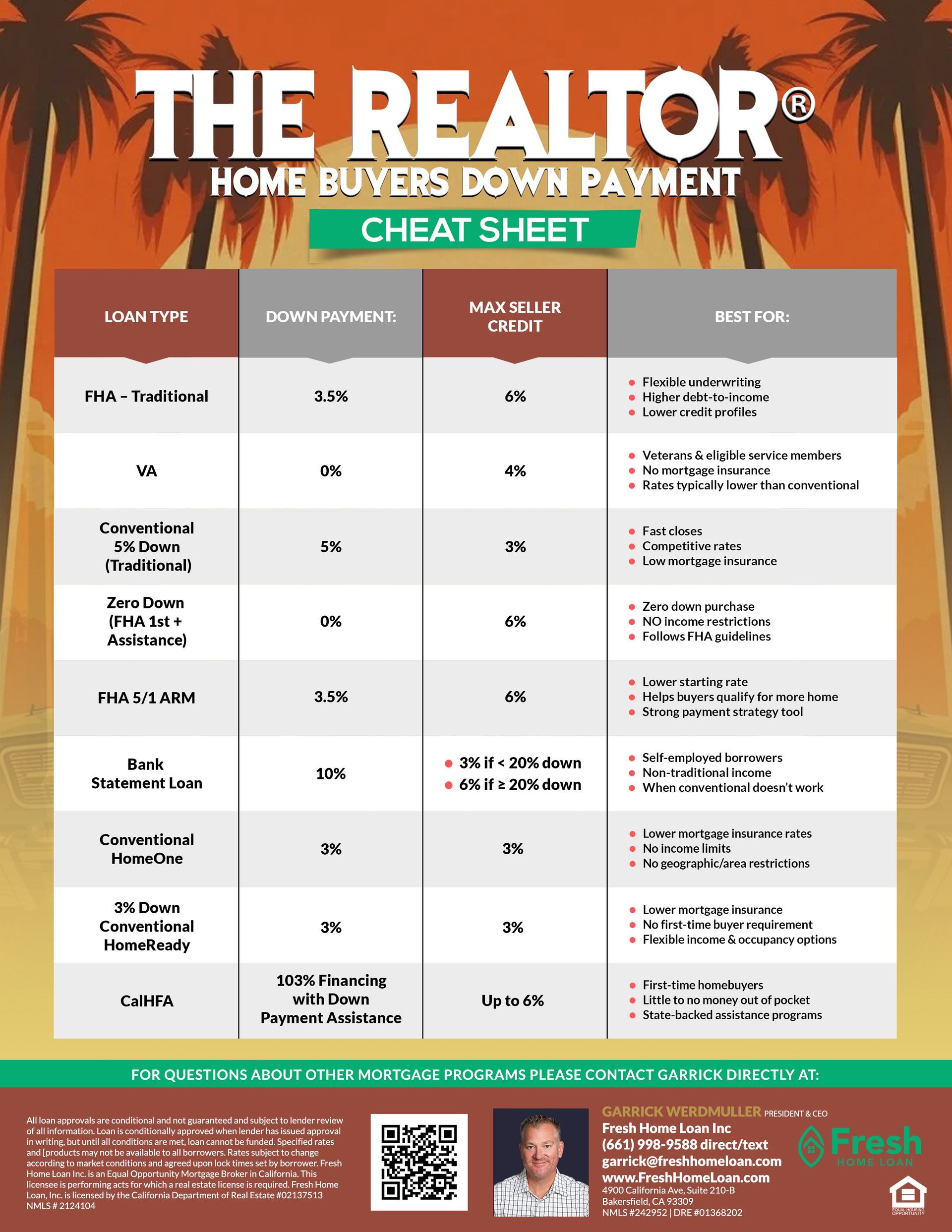
Buying a home is a significant milestone, and understanding your down payment options is crucial. “The Realtor® Home Buyers Down Payment Cheat Sheet” simplifies this process by outlining various loan types and their key features. Let's dive into some of the options available: 1. FHA - Traditional Down Payment: 3.5% Max Seller Credit: 6% Best For: Flexible underwriting, higher debt-to-income ratios, and lower credit profiles. 2. VA Loan Down Payment: 0% Max Seller Credit: 4% Best For: Veterans & eligible service members, offering no mortgage insurance and typically lower rates than conventional loans. 3. Conventional 5% Down (Traditional) Down Payment: 5% Max Seller Credit: 3% Best For: Fast closes, competitive rates, and low mortgage insurance. 4. Zero Down (FHA 1st + Assistance) Down Payment: 0% Max Seller Credit: 6% Best For: Zero down purchase, no income restrictions, and follows FHA guidelines. 5. FHA 5/1 ARM Down Payment: 3.5% Max Seller Credit: 6% Best For: A lower starting rate, helping buyers qualify for more home, and a strong payment strategy tool. 6. Bank Statement Loan Down Payment: 10% Max Seller Credit: 3% if < 20% down, 6% if ≥ 20% down Best For: Self-employed borrowers, those with non-traditional income, or when conventional loans don't work. 7. Conventional HomeOne Down Payment: 3% Max Seller Credit: 3% Best For: Lower mortgage insurance rates, no income limits, and no geographic/area restrictions. 8. 3% Down Conventional HomeReady Down Payment: 3% Max Seller Credit: 3% Best For: Lower mortgage insurance, no first-time buyer requirement, and flexible income & occupancy options. 9. CalHFA Down Payment: 103% Financing with Down Payment Assistance Max Seller Credit: Up to 6% Best For: First-time homebuyers, those needing little to no money out of pocket, and state-backed assistance programs.