Reverse Mortgage Self-Evaluation: A Checklist of Key Considerations

Get Your Official Copy of Reverse Mortgage Self-Evaluation: A Checklist of Key Considerations from the NRMLA (National Reverse Mortgage Loan Association)

Download File

This checklist was created to help you consider whether a reverse mortgage is right for you. Your HUD-approved reverse mortgage counselor can help you answer additional questions you may have about the loan. You can also find more information about reverse mortgage loans and the loan process onwww.reversemortgage.org, a consumer website created by the National Reverse Mortgage Lenders Association (NRMLA).


A reverse mortgage is a loan that enables homeowners who are generally 62 years of age or older to use part of their homes’ equity to obtain cash proceeds that can be used in many ways. The loan does not have to be repaid until the last surviving borrower or remaining eligible non-borrowing spouse passes away, permanently leaves the home, sells the home, or fails to meet the loan obligations, which include paying property taxes and insurance, and keeping the home maintained.


Nearly all reverse mortgage loans on the market today are federally insured Home Equity Conversion Mortgages (HECMs), though other types of reverse mortgage loans are offered by some states and private lenders. This Reverse Mortgage Self-Evaluation is based on the features and requirements of HECM reverse mortgages but may also be helpful to consumers considering other types of reverse mortgage loans.


Reverse mortgages are a versatile financial tool that over 1.35 million homeowners have used to age in place and for other reasons. However, like any financial product, reverse mortgages should be considered carefully before deciding whether to obtain one.


Questions to Ask Yourself Before Applying


You should ask yourself the following questions before proceeding with your loan application:


  1. How do you intend to use your reverse mortgage loan proceeds?
  2. Do you fully understand your obligations as a borrower under a reverse mortgage?
  3. If you are married, will your spouse be a co-borrower on your loan?
  4. How will your reverse mortgage loan be repaid?
  5. Do you receive assistance under any government programs that are based on your current income?
  6. How long do you, and your spouse, plan to remain in the home?
  7. Have you considered other strategies to supplement your retirement income?


1. How Do You Intend to Use Your Reverse Mortgage Loan Proceeds?


One of the advantages of a reverse mortgage loan is that borrowers generally have the freedom to use their cash proceeds any way they choose. Eligible homeowners obtain reverse mortgages for many reasons, including:


  • Paying off an existing mortgage
  • Repairing or modifying the home to meet the physical needs of aging
  • Supplementing retirement income to meet expenses
  • Managing the costs of in-home care
  • Paying bills or property taxes
  • Delaying Social Security
  • Providing funds for living expenses without liquidating investments
  • Establishing a line of credit for a financial safety net
  • Helping retirement savings last longer
  • Purchasing a retirement home


Do you have a plan for making your reverse mortgage loan proceeds last? Reverse mortgage loans are most successful when borrowers have a plan to ensure the money supports and sustains them for as long as they want to stay in their home.

It is never recommended to use loan proceeds to speculate on real estate or securities or to engage in risky investments. Loan originators are also not permitted to require or encourage borrowers to purchase other financial products, such as annuities or long-term care insurance, as a condition for obtaining a reverse mortgage.


2. Do You Fully Understand Your Obligations as a Borrower?


Reverse mortgage borrowers are not required to make monthly payments to their lender but must continue to meet certain obligations to stay current on the loan. Failure to meet these obligations may result in the loan becoming due and payable.


Borrowers must:

  • Live in the property for the majority of the calendar year
  • Maintain the condition of the home
  • Stay current on all property taxes, insurance, and any applicable homeowner or association fees
  • Comply with all other loan terms


Additionally, borrowers’ finances are reviewed to determine if they can sustain the ongoing costs associated with the reverse mortgage. Lenders may set aside a portion of the loan to pay property taxes and insurance premiums if needed.


3. If You Are Married, Will Your Spouse Be a Co-Borrower?


Under HECM reverse mortgage rules, borrowers must be at least 62, named on the home’s title, and use it as their principal residence. Spouses who do not meet these criteria may be identified as either eligible or ineligible non-borrowing spouses.


  • Co-borrower spouse survives you: Can continue living in the home and access remaining loan proceeds.
  • Eligible non-borrowing spouse survives you: May defer repayment and continue living in the home but cannot access remaining proceeds.
  • Ineligible non-borrowing spouse survives you: Cannot defer repayment.


4. How Will Your Reverse Mortgage Loan Be Repaid?


A reverse mortgage is a non-recourse loan, meaning the borrower or estate will never owe more than the loan balance or the home’s value, whichever is less. Loan repayment occurs when the last surviving borrower or eligible non-borrowing spouse passes away, permanently leaves, or sells the home.


Options for repayment include:


  • Selling the property and using proceeds to pay the loan
  • Using personal funds or gifted money
  • Purchasing the property for 95% of its appraised value
  • Providing a “deed in lieu of foreclosure”


Borrowers can also prepay all or part of the loan balance at any time without penalty.


5. Do You Receive Government Assistance?


Reverse mortgage proceeds generally do not affect Social Security or Medicare. However, they may impact eligibility for means-tested benefits like Medicaid or Supplemental Security Income (SSI) if retained in bank accounts. Consult a qualified financial advisor or elder law attorney for guidance.


6. How Long Do You Plan to Remain in the Home?


Reverse mortgages involve costs that should be considered relative to how long you plan to stay in your home. Shorter-term plans may make other strategies more cost-effective.


7. Have You Considered Other Strategies to Supplement Retirement Income?


Other ways to tap home equity include:


  • Renting out a room or home sharing
  • Refinancing an existing mortgage
  • Home equity loan or line of credit
  • Selling the home or selling and leasing back


Each option has benefits and drawbacks to review carefully.


Next Steps / Counseling


This checklist is designed to help you determine whether a reverse mortgage is right for you. Your HUD-approved reverse mortgage counselor can answer additional questions. More information is available atwww.reversemortgage.org, a consumer website created by the National Reverse Mortgage Lenders Association (NRMLA).


For personalized guidance and to discuss your reverse mortgage options, you can reach out to:


Garrick Werdmuller

President & CEO

Fresh Home Loan Inc.

(510) 282-5456

garrick@freshhomeloan.com

www.FreshHomeLoan.com


All loan approvals are conditional and not guaranteed and subject to lender review of all information. Loan is conditionally approved when the lender has issued approval in writing, but until all conditions are met, loan cannot be funded. Specified rates and [products may not be available to all borrowers. Rates subject to change according to market conditions and agreed upon lock times set by the borrower. Fresh Home Loan Inc. is an Equal Opportunity Mortgage Broker in California. This licensee is performing acts for which a real estate license is required. Fresh Home Loan, Inc. is licensed by the California Department of Real Estate #02137513 NMLS # 2124104


#ReverseMortgage #RetirementPlanning #FinancialPlanning #MortgageTips #HomeOwnership #SeniorFinance #FreshHomeLoan #FinancialSecurity


By Garrick Werdmuller April 7, 2026
En el entorno digital de hoy, muchos consumidores monitorean su crédito utilizando aplicaciones populares y herramientas en línea. Aunque estas plataformas brindan información útil, también pueden crear una falsa sensación de seguridad al prepararse para comprar una vivienda. La realidad es simple: No existe un solo puntaje de crédito universal. En cambio, existen múltiples modelos de puntuación, y cada uno está diseñado para un tipo específico de decisión financiera. Comprender esta diferencia es fundamental tanto para los compradores de vivienda como para los profesionales de bienes raíces. Diferentes industrias utilizan diferentes modelos de crédito El crédito se evalúa de manera distinta según el tipo de financiamiento que se esté considerando. • Los prestamistas de autos priorizan el historial en préstamos de auto a plazos • Los emisores de tarjetas de crédito se enfocan en el uso del crédito rotativo y la utilización disponible • Los brokers hipotecarios se centran en patrones de pago a largo plazo y consistencia financiera Como resultado, el puntaje de crédito de un consumidor puede variar considerablemente dependiendo del modelo que se utilice. Por ejemplo, una persona puede ver un puntaje de 720 en una aplicación para monitorear crédito, mientras que su puntaje específico para hipoteca podría estar más cerca de 680 .  Esta diferencia no es un error; simplemente refleja el uso de un modelo de puntuación distinto.
By Garrick Werdmuller April 7, 2026
In today’s digital landscape, many consumers monitor their credit using popular apps and online tools. While these platforms provide useful insights, they can also create a false sense of confidence when preparing for a home purchase. The reality is simple: There is no single, universal credit score. Instead, there are multiple scoring models, each designed for a specific type of lending decision. Understanding this distinction is critical for both homebuyers and real estate professionals. Different Industries Use Different Credit Models Credit is evaluated differently depending on the type of financing being considered. Auto lenders prioritize performance on installment-based auto loans Credit card issuers emphasize revolving credit behavior and utilization Mortgage lenders focus on long-term repayment patterns and financial consistency As a result, a consumer’s credit score can vary significantly depending on which model is used. For example, a consumer may see a 720 score through a credit monitoring app , while their mortgage-specific score may be closer to 680 . This discrepancy is not an error—it reflects the use of a different scoring model.
By Garrick Werdmuller March 26, 2026
A Simple Guide for Homebuyers and Realtors
By Garrick Werdmuller March 26, 2026
Una guía sencilla para compradores de casa y agentes
By Garrick Werdmuller March 13, 2026
Fresh Home Loan Marketing: What We Actually Deliver for Agents, Listings, and Buyers
By Garrick Werdmuller March 12, 2026
Building a home can feel complicated, but a One-Time Close New Construction loan helps simplify the process by combining construction financing and permanent mortgage financing into one loan. What is a One-Time Close New Construction loan? A One-Time Close New Construction loan is a single-close construction loan . It provides short-term financing for the construction of a new home, then converts into permanent mortgage financing once the project is complete. This type of loan can typically be structured as either a purchase or a refinance . What does “one-time close” mean? A one-time close construction loan combines: The financing for the construction phase The permanent mortgage after the home is completed There is one closing before construction begins , instead of separate closings for construction and permanent financing. At closing: The borrower’s required closing costs and funds are collected Construction funds are held and released through draws The builder typically receives an initial draw to begin the project What is a One-Time Close New Construction purchase loan? This is considered a purchase when the borrower does not already own the lot . The loan is used to finance: The purchase of the lot The cost to build the home The total loan amount is generally based on the lot purchase price plus construction costs , minus the borrower’s required down payment. What is a One-Time Close New Construction refinance loan? This is considered a refinance when the borrower already owns the lot the home will be built on. The loan is used to: Pay off any existing liens on the land, if applicable Finance construction of the new home The loan amount is generally based on the existing lot financing, if any, plus the cost to build the home . Can I build a barndominium or other unique property? Possibly. Barndominiums and other unique property types may be eligible depending on the loan program guidelines and whether the appraisal can support the value with comparable sales in the area. Unique properties are often more appraisal-sensitive, so approval depends heavily on market support. What happens if the build takes longer than expected? The builder and borrower agree on the expected construction timeline upfront. During the build, inspections and permit reviews are typically completed before draws are released, which helps identify delays early. If the project runs longer than expected: Updated credit or income documents may be required if prior documents expire The borrower may need to be requalified if major eligibility issues arise The lender will review the file and determine what updated documentation is needed How many units are allowed on one parcel? Programs may allow up to 4 attached units on one parcel , depending on the loan type and guidelines. An Accessory Dwelling Unit (ADU) may also be allowed, but it typically counts as a unit, subject to local zoning and program rules. If there is an ADU on the parcel, the principal residence may be limited to 3 units . Can I build a home with a pool, ADU, detached garage, or other upgrades? Yes, borrowers can usually build to the specifications they agree on with their builder. However, financing for those features depends on whether the appraised value supports the total cost . If the project cost exceeds the program’s maximum loan-to-value limits, the borrower may need to bring additional funds to closing. Can I build on land that already has a home on it? Typically, land with an existing dwelling is not eligible for a standard One-Time Close New Construction transaction unless the property is legally re-parceled to separate the new build from the existing structure. Can I demolish an existing home and build a new one? In some cases, yes. For certain conventional transactions, the existing foundation may be reused if it meets local building code and program requirements. For VA transactions, the existing foundation generally cannot be reused, and the new construction must follow VA-specific guidelines. Can demolition costs be included in the loan? In many cases, yes. Demolition costs can often be included in the construction budget. As with other project costs, financing depends on whether the appraised value supports the total project and whether the loan stays within program limits. Any amount above allowed limits may need to be paid by the borrower at closing. Do the builder and project need to be approved before submitting the loan? Builder and project approval may not always be required before initial submission, but it is strongly recommended to have them reviewed early. Final approval is generally needed before the loan can receive final clearance to close. Early review helps avoid surprises and keeps expectations clear for all parties. How is the borrower’s down payment or cash to close applied during construction? When a borrower brings funds to closing, those funds are generally applied first toward: Closing costs Initial project costs Early draws, depending on the structure of the loan After those funds are used, the remaining construction costs are funded through the loan proceeds. When does the builder receive the initial draw? After closing, construction funds are held in escrow and disbursed once all required conditions for the first draw are met. The initial draw is typically released after approval and setup are complete. Timing can vary, but builders should expect a short processing period before funds are disbursed. Can the builder give a credit toward closing costs? Yes, builder credits may be allowed, but they must comply with interested party contribution limits for the applicable loan program. These credits are typically reflected in the transaction and may reduce the funds otherwise paid to the builder. What happens if the borrower has questions after closing? After the loan closes, the borrower will usually receive welcome and servicing information explaining how the construction loan will be administered. Borrowers should contact their loan servicer or construction servicing team for questions about: Payments Draw process Construction servicing Loan modification into permanent financing Fresh Home Loan can also help guide borrowers on who to contact. Does the builder have to use a specific budget form? It is often best for the builder to complete the lender’s preferred construction budget form if one is available. However, a builder’s standard budget may also work as long as it includes all required construction details, line items, and costs. What if the construction budget changes before closing? If the budget changes before closing, an updated budget and any required contract addendum will typically need to be submitted. The loan file may need to be updated, and in some cases an additional review fee may apply if the changes are significant. Can a borrower be reimbursed for construction items paid before closing? Generally, borrowers should not expect reimbursement in cash for construction items they prepaid before closing. For some conventional refinance transactions, prepaid builder deposits may not be reimbursable through loan proceeds. How do interest-only payments work during construction? During the construction phase, the borrower typically makes interest-only payments based on the amount of funds that have been disbursed. In some cases, builder-paid interest arrangements may be structured into the transaction if allowed by the loan program and documented properly. Borrowers usually receive monthly statements showing construction-period interest activity. Can there be an escrow holdback if the project is delayed by weather? Generally, escrow holdbacks are not allowed on standard One-Time Close Conventional or VA construction loans. Builders should account for seasonal conditions when planning the project timeline. How does the builder receive the final draw? Before the final draw is released, a final inspection is usually required to confirm that the work has been completed according to plan. Final draw processing can take additional time, so builders and borrowers should plan ahead near the end of the project. Are owner-builders allowed? Owner-builders may be allowed on certain conventional One-Time Close programs, but they typically must go through a builder approval process. Additional requirements may apply, including: Higher down payment requirements Stronger reserves Additional documentation Stricter qualification standards Can a borrower who already started construction transition into a One-Time Close loan? Sometimes, yes — but usually only on certain conventional programs. If construction has already started, the lender will typically require: Permits Inspections Documentation of completed work Updated budget and plans This type of scenario is more complex and may have added restrictions. Can borrowers be reimbursed for materials they bought outside the loan? Borrowers generally cannot receive cash reimbursement for materials purchased outside of the transaction. However, in some cases, those contributions may be credited as equity toward the borrower’s down payment, subject to documentation and program approval. Can future rental income from the property be used to qualify? No. Future rental income from the subject property typically cannot be used to qualify for a One-Time Close New Construction loan. Important note One-Time Close New Construction loans can be a great option, but guidelines vary based on: Loan type Occupancy Property type Builder approval Appraisal support Borrower qualifications That is why it is important to review the project upfront with a knowledgeable mortgage professional. Questions about your construction project? We help homebuyers and Realtors understand the financing side of building a home — from lot purchase to final permanent financing. Reach out to Fresh Home Loan to review your scenario. Garrick Werdmuller President & CEO Fresh Home Loan Inc. (510) 282-5456 garrick@freshhomeloan.com www.FreshHomeLoan.com All loan approvals are conditional and not guaranteed and subject to lender review of all information. Loan is conditionally approved when lender has issued approval in writing, but until all conditions are met, loan cannot be funded. Specified rates and [products may not be available to all borrowers. Rates subject to change according to market conditions and agreed upon lock times set by borrower. Fresh Home Loan Inc. is an Equal Opportunity Mortgage Broker in California. This licensee is performing acts for which a real estate license is required. Fresh Home Loan, Inc. is licensed by the California Department of Real Estate #02137513 NMLS # 2124104 #OneTimeClose #ConstructionLoan #BuildYourDreamHome #HomeConstruction #HomeBuildingProcess #MortgageEducation #HomeBuyingTips #RealEstate #FirstTimeHomeBuyer #MortgageBroker #LoanPrograms #FreshHomeLoan 
By Garrick Werdmuller March 4, 2026
In today’s California real estate market, seller credits are making a strong comeback. As mortgage rates remain elevated and buyers become increasingly payment-focused, seller concessions are no longer just a closing cost tool — they are a strategic financing solution. Fresh Home Loan Inc., led by independent mortgage broker Garrick Werdmuller (DRE 01368202 | NMLS 242952), has released the Realtor® Home Buyers Seller Credit Cheat Sheet to help agents and buyers structure smarter offers in today’s lending environment. Understanding how seller credits work — and how to use them properly — can be the difference between a deal falling apart and a deal closing cleanly. What Are Seller Credits? Seller credits (also called seller concessions) are negotiated funds the seller agrees to contribute toward a buyer’s allowable closing costs. Instead of reducing the purchase price, the seller allocates funds at closing to cover approved expenses under lending guidelines. In many cases, structured seller credits create stronger financial outcomes than price reductions alone. Why Seller Credits Matter in Today’s Market California buyers are currently navigating: Higher mortgage rates Payment-driven affordability concerns Reduced liquidity among first-time buyers Appraisal sensitivity in softening price pockets Increased use of temporary and permanent rate buydowns Because buyers are payment-focused, not price-focused, strategic seller credits can: Lower monthly payments Preserve appraisal value Improve qualification ratios Keep more cash in the buyer’s bank account Negotiation structure is outperforming price reductions. What Seller Credits CAN Be Used For Under FHA, conventional, and other agency guidelines, seller concessions may typically be used for: 1. Closing Costs Lender fees (origination, underwriting, processing) Appraisal and credit report Title and escrow fees Recording fees Flood certification Attorney fees (where applicable) These are the most common uses of seller concessions. 2. Prepaid Items Seller credits may cover prepaid costs required at closing, including: Homeowners insurance Property taxes Per diem mortgage interest HOA dues (where applicable) This can significantly reduce the buyer’s required cash to close. 3. Interest Rate Buydowns (Power Move) One of the most powerful uses of seller credits in 2026 is for rate buydowns. Temporary Buydowns 2-1 buydown 1-0 buydown These reduce the buyer’s payment for the first one or two years. Permanent Buydowns Discount points to permanently reduce the interest rate In a higher-rate environment, structured credits toward discount points can dramatically improve affordability. 4. Mortgage Insurance (MI) Seller concessions may be used toward: FHA Upfront Mortgage Insurance Premium (UFMIP) Certain lender-paid mortgage insurance structures on conventional loans This can help optimize long-term payment strategy. 5. Repairs or Credits in Lieu of Repairs Post-inspection negotiations may include seller credits for: Health and safety repairs Deferred maintenance Repair credits instead of seller-completed work This must comply with lender and appraisal guidelines. 6. HOA and Condo Costs For condos and planned developments, credits may cover: HOA transfer fees HOA dues at closing Condo document fees What Seller Credits CANNOT Be Used For There are clear compliance limits. Seller concessions generally cannot be used for: Down payment Cash back to buyer Paying off buyer’s personal debt Furniture or personal property Side agreements outside escrow Exceeding concession limits can create underwriting delays or contract amendments. Understanding the boundaries protects approval confidence. Seller Credits vs. Price Reduction: Which Is Better? Many agents assume reducing the purchase price is always best. But consider this example: A $20,000 price reduction may lower the monthly payment only marginally. The same $20,000 structured as seller credits could: Buy down the interest rate Lower the buyer’s payment more aggressively Reduce required cash to close Improve debt-to-income qualification Preserve appraised value Payment structure closes transactions. Seller Concession Limits Matter FHA, conventional, and other loan types have maximum allowable seller concession percentages based on: Loan type Down payment Occupancy Purchase price Structuring credits within guidelines is critical to ensure a clean approval. This is where working with an experienced independent mortgage broker matters. Strategic Takeaway for California Realtors Seller credits are no longer just a closing cost offset. They are: A negotiation advantage A payment strategy tool A qualification improvement lever A liquidity preservation mechanism A compliance-sensitive structuring opportunity Agents who understand seller credit strategy will outperform those who rely solely on price reductions. Get the Realtor® Home Buyers Seller Credit Cheat Sheet Fresh Home Loan’s one-page Seller Credit Cheat Sheet was created as a field-level reference for: Listing agents Buyer’s agents First-time homebuyers Move-up buyers Real estate investors
By Garrick Werdmuller March 4, 2026
In today’s California real estate market, seller credits are making a strong comeback. As mortgage rates remain elevated and buyers become increasingly payment-focused, seller concessions are no longer just a closing cost tool — they are a strategic financing solution. Fresh Home Loan Inc., led by independent mortgage broker Garrick Werdmuller (DRE 01368202 | NMLS 242952), has released the Realtor® Home Buyers Seller Credit Cheat Sheet to help agents and buyers structure smarter offers in today’s lending environment. Understanding how seller credits work — and how to use them properly — can be the difference between a deal falling apart and a deal closing cleanly. What Are Seller Credits? Seller credits (also called seller concessions) are negotiated funds the seller agrees to contribute toward a buyer’s allowable closing costs. Instead of reducing the purchase price, the seller allocates funds at closing to cover approved expenses under lending guidelines. In many cases, structured seller credits create stronger financial outcomes than price reductions alone. Why Seller Credits Matter in Today’s Market California buyers are currently navigating: Higher mortgage rates Payment-driven affordability concerns Reduced liquidity among first-time buyers Appraisal sensitivity in softening price pockets Increased use of temporary and permanent rate buydowns Because buyers are payment-focused, not price-focused, strategic seller credits can: Lower monthly payments Preserve appraisal value Improve qualification ratios Keep more cash in the buyer’s bank account Negotiation structure is outperforming price reductions. What Seller Credits CAN Be Used For Under FHA, conventional, and other agency guidelines, seller concessions may typically be used for: 1. Closing Costs Lender fees (origination, underwriting, processing) Appraisal and credit report Title and escrow fees Recording fees Flood certification Attorney fees (where applicable) These are the most common uses of seller concessions. 2. Prepaid Items Seller credits may cover prepaid costs required at closing, including: Homeowners insurance Property taxes Per diem mortgage interest HOA dues (where applicable) This can significantly reduce the buyer’s required cash to close. 3. Interest Rate Buydowns (Power Move) One of the most powerful uses of seller credits in 2026 is for rate buydowns. Temporary Buydowns 2-1 buydown 1-0 buydown These reduce the buyer’s payment for the first one or two years. Permanent Buydowns Discount points to permanently reduce the interest rate In a higher-rate environment, structured credits toward discount points can dramatically improve affordability. 4. Mortgage Insurance (MI) Seller concessions may be used toward: FHA Upfront Mortgage Insurance Premium (UFMIP) Certain lender-paid mortgage insurance structures on conventional loans This can help optimize long-term payment strategy. 5. Repairs or Credits in Lieu of Repairs Post-inspection negotiations may include seller credits for: Health and safety repairs Deferred maintenance Repair credits instead of seller-completed work This must comply with lender and appraisal guidelines. 6. HOA and Condo Costs For condos and planned developments, credits may cover: HOA transfer fees HOA dues at closing Condo document fees What Seller Credits CANNOT Be Used For There are clear compliance limits. Seller concessions generally cannot be used for: Down payment Cash back to buyer Paying off buyer’s personal debt Furniture or personal property Side agreements outside escrow Exceeding concession limits can create underwriting delays or contract amendments. Understanding the boundaries protects approval confidence. Seller Credits vs. Price Reduction: Which Is Better? Many agents assume reducing the purchase price is always best. But consider this example: A $20,000 price reduction may lower the monthly payment only marginally. The same $20,000 structured as seller credits could: Buy down the interest rate Lower the buyer’s payment more aggressively Reduce required cash to close Improve debt-to-income qualification Preserve appraised value Payment structure closes transactions. Seller Concession Limits Matter FHA, conventional, and other loan types have maximum allowable seller concession percentages based on: Loan type Down payment Occupancy Purchase price Structuring credits within guidelines is critical to ensure a clean approval. This is where working with an experienced independent mortgage broker matters. Strategic Takeaway for California Realtors Seller credits are no longer just a closing cost offset. They are: A negotiation advantage A payment strategy tool A qualification improvement lever A liquidity preservation mechanism A compliance-sensitive structuring opportunity Agents who understand seller credit strategy will outperform those who rely solely on price reductions. Get the Realtor® Home Buyers Seller Credit Cheat Sheet Fresh Home Loan’s one-page Seller Credit Cheat Sheet was created as a field-level reference for: Listing agents Buyer’s agents First-time homebuyers Move-up buyers Real estate investors 
By Garrick Werdmuller February 27, 2026
As seller credits return to negotiations and buyers become more payment-conscious, understanding down payment structure is becoming just as important as purchase price.
By Garrick Werdmuller February 24, 2026
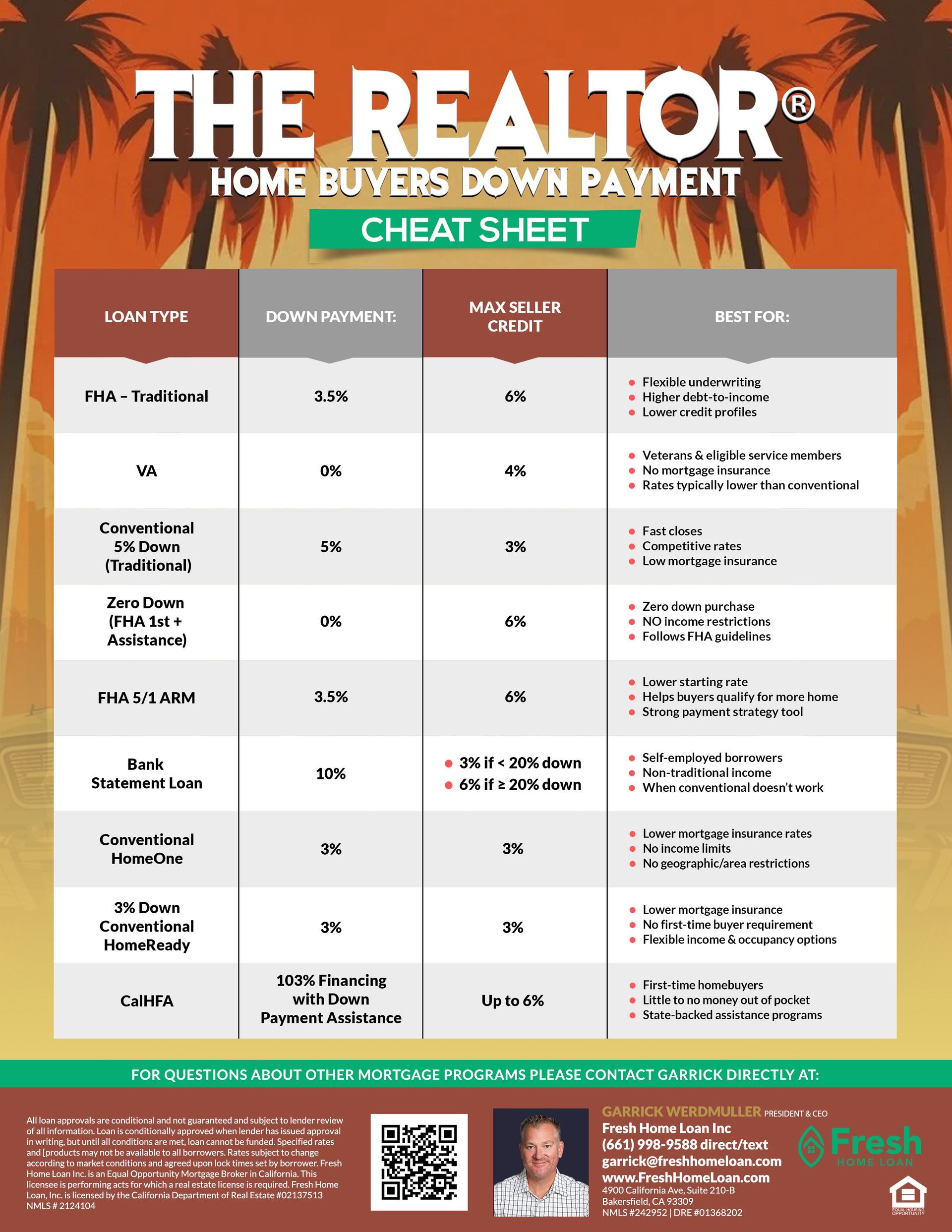
Buying a home is a significant milestone, and understanding your down payment options is crucial. “The Realtor® Home Buyers Down Payment Cheat Sheet” simplifies this process by outlining various loan types and their key features. Let's dive into some of the options available: 1. FHA - Traditional Down Payment: 3.5% Max Seller Credit: 6% Best For: Flexible underwriting, higher debt-to-income ratios, and lower credit profiles. 2. VA Loan Down Payment: 0% Max Seller Credit: 4% Best For: Veterans & eligible service members, offering no mortgage insurance and typically lower rates than conventional loans. 3. Conventional 5% Down (Traditional) Down Payment: 5% Max Seller Credit: 3% Best For: Fast closes, competitive rates, and low mortgage insurance. 4. Zero Down (FHA 1st + Assistance) Down Payment: 0% Max Seller Credit: 6% Best For: Zero down purchase, no income restrictions, and follows FHA guidelines. 5. FHA 5/1 ARM Down Payment: 3.5% Max Seller Credit: 6% Best For: A lower starting rate, helping buyers qualify for more home, and a strong payment strategy tool. 6. Bank Statement Loan Down Payment: 10% Max Seller Credit: 3% if < 20% down, 6% if ≥ 20% down Best For: Self-employed borrowers, those with non-traditional income, or when conventional loans don't work. 7. Conventional HomeOne Down Payment: 3% Max Seller Credit: 3% Best For: Lower mortgage insurance rates, no income limits, and no geographic/area restrictions. 8. 3% Down Conventional HomeReady Down Payment: 3% Max Seller Credit: 3% Best For: Lower mortgage insurance, no first-time buyer requirement, and flexible income & occupancy options. 9. CalHFA Down Payment: 103% Financing with Down Payment Assistance Max Seller Credit: Up to 6% Best For: First-time homebuyers, those needing little to no money out of pocket, and state-backed assistance programs.